Showing posts with label sports massage. Show all posts

Tuesday, June 12, 2012

Online Massage Therapy Training for Scoliosis

What is Scoliosis?

Scoliosis is an abnormal lateral (sideways) curve of the spinal vertebrae. There are several causes for this lateral curvature: it can be caused by degeneration of the joints, prolonged postural issues, and severe back injuries. Scoliosis can be structural scoliosis (the bones themselves are affected) or functional scoliosis (the muscles are pulling the back out of place). It is not uncommon for people to have a small degree of curvature that never affects their daily life. Depending on its severity, you may not even need the slightest treatment, or only need occasional physical therapy, and seldom need for surgery for correction.

Why Massage?

Whatever the cause of the scoliosis, prolonged improper body mechanics can affect the body in a lot of ways. What may have started as a minor curve can gradually worsen as the affected muscles tire, atrophy, and stretch or contract (depending on which side of the curve they are on). Massage helps these muscles by relaxing them and encouraging them to work towards a proper alignment. Muscles on the inside of the curve are stretched and released, while muscles on the outside are stimulated to contract harder. Often a gradually increasing curve can be stopped or even partially reversed with consistent therapy, stretching, and balancing strengthening work.


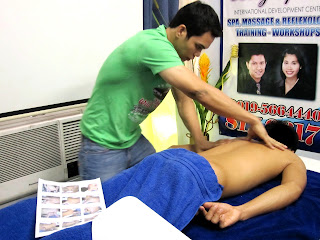


Contact us for FREE lecture cd / FREE spa music cd / FREE trial lessons.
http://www.bodyoptions.net/ * (+63) 939-6410000 * (+63) 916-3410000
(+632) 519-6192 * (+632) 774-2400


Monday, June 11, 2012

Why Train for Deep Tissue Massage?

What is Deep Tissue Massage?

Deep Tissue Massage is a massage modality that focuses on deeper layers of muscles. It aims to release the chronic patterns of tension in the body through slow strokes and deep finger pressure on the contracted areas, either following or going across the fibers of the muscles, tendons or fascia.
This type of massage releases chronic muscle tension through slower strokes and more direct deep pressure or friction applied across the grain of the muscles not with the grain. Deep tissue massage helps to break up and eliminate scar tissue. Deep tissue massage usually focuses on more specific areas and may cause some soreness during or right after the massage. However, if the massage is done correctly you should feel better than ever within a day or two.
Why should one get a Deep Tissue Massage?
This special massage feels good and it is beneficial to health. When muscles are stressed, they impede the regular flow of oxygen and nutrients, leading to inflammation that builds up toxins in the muscle tissue. A deep-tissue massage helps loosen muscle tissues, release toxins from muscles and get blood and oxygen circulating properly. Because many toxins are released, it's important to drink plenty of water after a deep-tissue session to help eliminate these toxins from the body.
What is the purpose of Deep Tissue Massage?
The purpose is to separate the fibers of a muscle while releasing deeply-held patterns of tension, removing toxins, while relaxing and soothing the muscle. It is both corrective and therapeutic.


Contact us for FREE lecture cd / FREE spa music cd / FREE trial lessons.
(+63 2) 638-8446 * (+63) 917-7121100 * www.bodyoptions.net


Monday, May 24, 2010

Massage Therapy for Muscle Cramps

Muscular cramps happen most often in legs. The leg muscles are vulnerable to cramping because they're large muscles that do a lot of work. Cramps in the hamstrings and quadriceps are both common, but from my experience I'd say that the most common type of leg cramps is the calf muscle cramp.

There are a few things that contribute to getting muscle cramps. It used to be that lack of salt was the major cause of cramps, but we get so much salt in our diet these days in the form of processed foods so that's probably not the problem. Here are some other more likely contributing factors:
  • Lack of potassium can cause muscles to cramp. Potassium helps regulate your muscle's activity and is important for healthy muscle function.
  • Electrolyte imbalance can happen easily if you're doing a lot of strenuous activity that makes you sweat and you're not properly replacing lost electrolytes.
  • Overwork can also contribute. If you work out too hard or strain lifting too much weight, your muscle could go into spasm.
  • Dehydration occurs when you don't drink enough fluids. If your muscles are dehydrated they don't have the lubrication they need to function correctly.
If you weren't sleeping when your cramp occurred, you can do a few things to follow up. Try putting ice on the area. Remember that when you do ice an area you shouldn't apply ice for longer than 15 minutes every hour.
Once you've iced it you can do some petrissage on the area to get the blood flowing properly. When a muscle cramps up it restricts the blood flow to the tissue.

After a good massage be sure to stretch the area. The stretching will also help loosen the muscle tissue even more.

Sometimes the area where the leg cramp was will remain sore even after the cramp has gone away. This happens because some muscle fibers may have been damaged or torn because the cramp was so intense. Getting a massage from a professional therapist will help you deal with that injury.


For FREE seminars / TRIAL lessons / FREE cd-vcd's
(+63 2) 638-8446 * (+63) 917-7121100 * www.bodyoptions.net

Online / Long Distance Massage Training for the Sprained Ankle

Having a sprained ankle is one of the most common types of ankle injury, chiefly in athletics. It results when the ankle ligaments are either stretched or torn. Most frequently, an ankle sprain is caused by the ankle spinning under so that the sole of foot is facing inwards, injuring the ligaments that are on the outside of the ankle. More rarely, the ankle will roll the other way and injure the ligaments on the inside of the ankle. Cross friction massage applied to the affected ligaments after the injury will help to prevent scar tissue from forming.
  1. Wait for at least 48 to 72 hours before you begin any massage, which should only be done in the sub-acute and acute stage.
  2. Make certain that there are no contraindications such as a broken bone, open wound, skin infections, and tendon ruptures, chilblains and the like. If any, you must not perform the massage.
  3. Convene the person with the ankle sprain in the resting position. Widen out the foot with the sprained ankle, so that the ligaments are in a stretched position.
  4. Apply a deep, direct pressure on the ligament using a single finger. Begin the manipulation at a point that is faintly away from the sprained area, and then work your way gradually towards it. Massage deeply back and forth ACROSS the ligament, not along its length. You should feel the ligament under the skin.
  5. Slowly begin to massage even deeper, but within the limits of bearable pain. Continue the massage for five to ten minutes. Tape the ankle or use an ankle support to support it.
  6. Massage the ankle with the same method every other day, not every day. After this deep-massage technique, the sprained ankle will need some time to recover. If the pain or swelling is worse the next day, then put off the massage again.


For FREE seminars / TRIAL lessons / FREE cd-vcd's
(+63 2) 638-8446 * (+63) 917-7121100 * www.bodyoptions.net

Sunday, May 23, 2010

Massage Therapy and Sports Massage

Sports massage is a therapy that helps athletes and active people to enhance performance, reduce injury and speed up recovery times. A sports massage therapist employs a variety of techniques to ease muscle tension and improve circulation to affected areas of the body.

There are many benefits to regular sports massage treatment

Recovery is the main benefit – the tired muscles are being stretched and the metabolic waste and toxins that build up in muscles are released. The nutrients in the fresh blood being pumped into the muscles helps speed up the recovery process by repairing muscle damage, controls inflammation and any associated pain.

Massage also alleviates trigger points within the muscles, breaks down adhesions and the build up of scar tissue – all of which can affect the function of key muscle groups when racing and training.

Injury prevention is vital – there is no point putting time and effort into hard training sessions only to become injured weeks or days before a key event in the season.

Injury rehabilitation – again there is no point putting the hard effort in only to miss key races during a season because injuries keep returning.

You get to know your body better – this has the benefit of being able to focus key sessions on strengthening weak areas of the muscles and again is key to injury prevention.

It is has psychological benefits – the muscles learn to relax, you know that you body is feeling good before going into a key race or block of hard training and you know that your body is in peak condition.


For FREE seminars / TRIAL lessons / FREE cd-vcd's
(+63 2) 638-8446 * (+63) 917-7121100 * www.bodyoptions.net

Saturday, October 31, 2009

Canadian Sports (Athletic) Massage

In Canadian Sports Massage, learn how to evaluate an injury within the scope of a massage practice, when to refer out and what specific massage techniques are beneficial to use depending on the injury. Learn which techniques are contraindicated and when to apply ice or heat. Massage Therapists are often confronted with clients that present soft tissue injuries from athletic activities. They want to know what they should do about the injury, if they should stop the activity or sport, see a doctor, self treat, leave it alone, use ice or heat and a myriad of questions concerning the dilemma.


For FREE seminars / TRIAL lessons / FREE cd-vcd's
(+63 2) 638-8446 * (+63) 917-7121100 * www.bodyoptions.net